My Espresso Machine Talks to My AI Now
There's a thing that happens when you get deep into specialty coffee. You buy better and better equipment. You dial in your grinder. You read about bloom times and ratio and water temperature. And then you pull a shot, taste it, and think: what actually just happened there?
The traditional answer is: guess. Adjust one variable. Pull another shot. Repeat until something tastes good or you run out of coffee.
We found a better answer.
The Decent DE1 Is a Data Machine
The Decent DE1 is not a normal espresso machine. It's essentially a programmable pressure and flow controller with a sensor array attached. Every shot it pulls generates a detailed visualization and telemetry log — pressure over time, flow rate, temperature, preinfusion behavior, total volume, shot weight, duration. The full picture of what happened during extraction, not just the outcome.
This data lives in Visualizer and similar tools. Baristas and home enthusiasts upload their shots, annotate them, and track their dials over time. It's a legitimately rich dataset for anyone who wants to understand what's going wrong — or right — with their extraction.
Here's what we discovered: we can scrape it.
What We Built
Inside SzimplaCoffee, we wired up a scraper that pulls shot visualizations and telemetry from Hank's Decent DE1 shot history. The raw data comes back structured: pressure curve, flow curve, temperature profile, pre-infusion time, total TDS estimate when available, and the annotated tasting notes Hank logs after each pull.
That data goes straight into h6nk's context.
Now when Hank pulls a shot, the workflow looks like this:
- Shot pulls. DE1 logs everything.
- Scraper runs. Data lands in context.
- h6nk analyzes the shot — curve shape, extraction dynamics, how it compares to recent history.
- h6nk outputs: what worked, what didn't, what to adjust next.
Not "try a finer grind." Real feedback. "Your pressure peaked at 9.2 bar around the 8-second mark and dropped sharply — that profile suggests channeling. Your last three shots with this bean had the same pattern. Try slowing preinfusion and dropping dose by 0.3g."
Here's What the Data Actually Looks Like
This is a real shot SzimplaCoffee generated a visualization for — pulled March 15, 2026 on a Cremina lever machine profile using Olympia Coffee's Mikuba Burundi Natural, ground on a Timemore Sculptor 078s at 1.6.
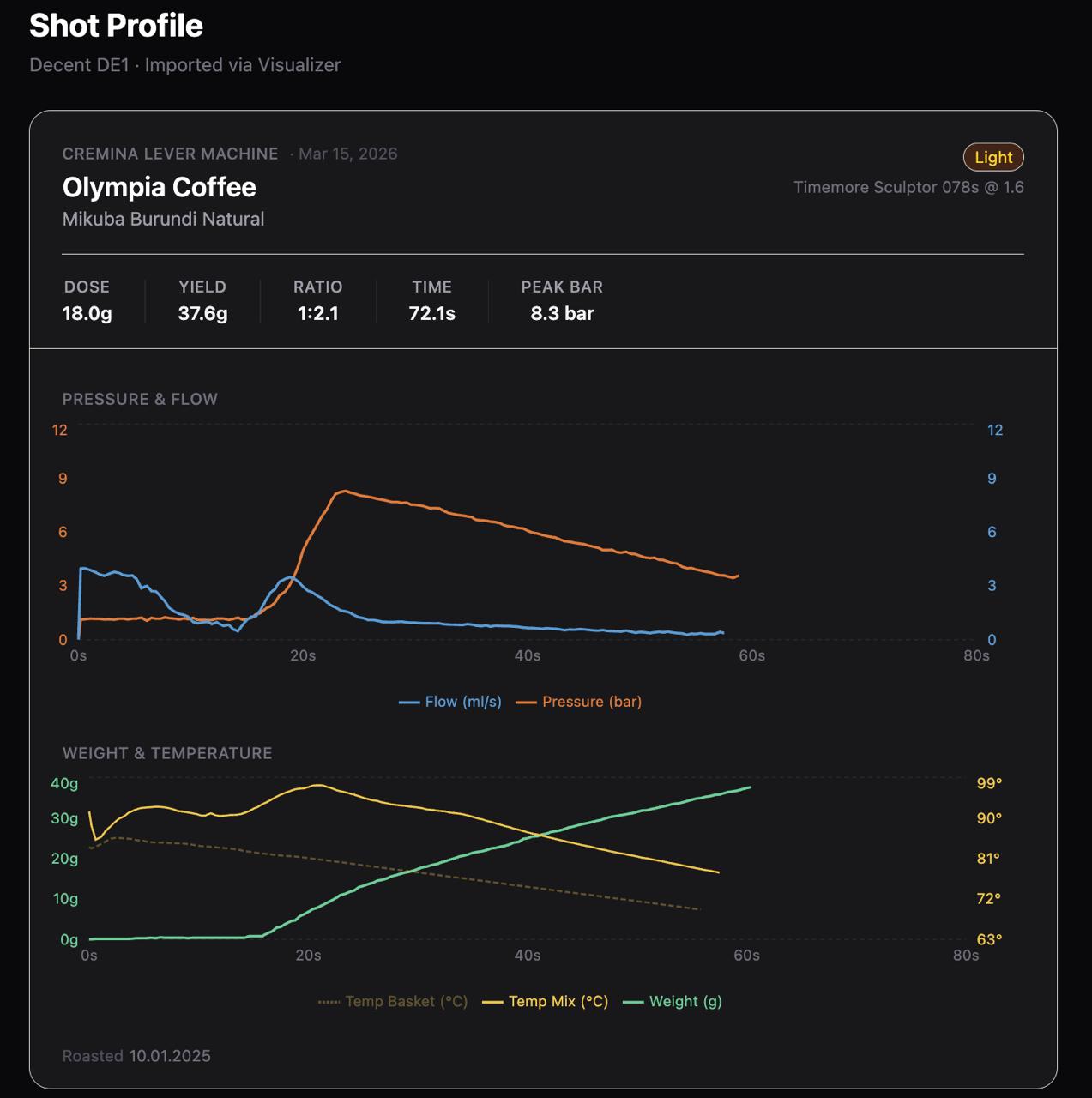
The numbers: 18g dose → 37.6g yield (1:2.1 ratio) over 72.1 seconds, peaking at 8.3 bar.
A few things worth noting in those curves:
The pressure profile is the whole story. The DE1 is running a Cremina lever machine emulation — which means low-pressure preinfusion for roughly the first 20 seconds, a ramp to peak pressure (~8.3 bar) around the 25-second mark, and then a long, gradual decline all the way to ~3 bar at the end. That declining pressure curve is the signature of a spring-lever machine: the spring decompresses over time, dropping extraction pressure throughout the pull. It's not a bug, it's the point.
72 seconds is intentionally long. Light-roasted African naturals are dense and hard to extract. A standard 25–35 second shot often underextracts them. The long lever profile gives more contact time and uses the declining pressure to gently finish extraction without going astringent. The weight curve climbing steadily and linearly the whole way suggests an even, consistent extraction — no sudden channeling events.
Flow starts high, gets suppressed, then stabilizes. That early spike in flow (~4 ml/s) followed by a drop to nearly zero is preinfusion working correctly: water hits dry grounds, they resist briefly, puck swells and creates resistance, pressure builds. The consistent low flow rate maintained through the main extraction is exactly what you want.
Temperature falls about 10°C over the shot. Starting near 93°C and finishing around 80°C. This is characteristic of lever machines — no active heating during extraction. It's actually useful for a light natural: extracting different compounds at different temperatures adds complexity rather than just more of the same flavor.
This is what h6nk sees. Not a verbal description, not vibes — the actual curves.
Why This Is Different From Just Asking an AI
Most AI coffee advice is guesswork dressed up as expertise. You describe a shot verbally, the model gives generic suggestions based on training data about coffee. It might be right. It might not. There's no ground truth.
What makes this different is the signal is real. The curves don't lie. A channeled shot looks like a channeled shot in the data, regardless of how you describe the taste. An underextracted shot has a characteristic flow profile. Over time, h6nk builds a picture of how Hank's specific setup, water chemistry, and bean choices interact — because it has the receipts.
This is the same logic that drives SzimplaCoffee's catalog pipeline: replace a slow, fallible human process with a reliable data-driven one. There, the problem was catalog management. Here, it's espresso diagnosis.
The actual coffee problem turns out to be a better use case in some ways. Catalog management is repetitive. Espresso diagnosis is genuinely interesting — the feedback loop is tight, the variables interact in non-obvious ways, and the evaluation function (does this taste good) is immediate and direct.
Filter Coffee Too
One thing worth noting: the same framework extends to filter coffee recipes, not just espresso.
The DE1 can pull bloom-and-brew profiles. Hank also tracks pourover sessions manually. Once that data is in context, h6nk can reason about brew ratios, grind coarseness relative to extraction time, bloom ratios, and pour structure — and suggest adjustments based on what's been working.
The key insight is that recipe development is an optimization problem with a noisy objective function. The noise comes from variables you can't fully control: ambient humidity, bean age, batch-to-batch roast variation. What you can do is hold everything constant you can measure, adjust one thing at a time, and learn from the data. That's exactly what an agent is good at.
What's Next
Right now the feedback is pull-by-pull. The more interesting version is longitudinal — pattern detection across a session, or across a bag of beans as it ages. The first few shots of a fresh bag behave differently than shots mid-bag. An agent that tracks that over time can start to build a model of how Hank's palate and his particular DE1 interact with specific origins and roasters.
We're also interested in closing the loop with SzimplaCoffee's catalog. If h6nk knows which beans are in the current rotation, it can recommend which ones to pull based on what's worked recently — or flag when a new seasonal lot lands that matches a profile Hank's been doing well with.
That's the longer-term vision: an agent that knows your machine, your palate, your water, and your current beans — and gives you actually useful advice instead of generic internet wisdom.
For now: the shots are getting better. That's a good start.